Blog


.png)

Democratizing AI Compute Series
Go behind the scenes of the AI industry with Chris Lattner
Latest

Semantic Search with MAX Engine
In the field of natural language processing (NLP), semantic search focuses on understanding the context and intent behind queries, going beyond mere keyword matching to provide more relevant and contextually appropriate results. This approach relies on advanced embedding models to convert text into high-dimensional vectors, capturing the complex semantics of language.

How to Be Confident in Your Performance Benchmarking
Mojo as a language offers three main benefits, namely the 3 P’s: Performance, Programmability and Portability. It enables users to write fast code, do so easier than many alternative languages, and allows code to be run across different CPU platforms, with GPU support on the roadmap.
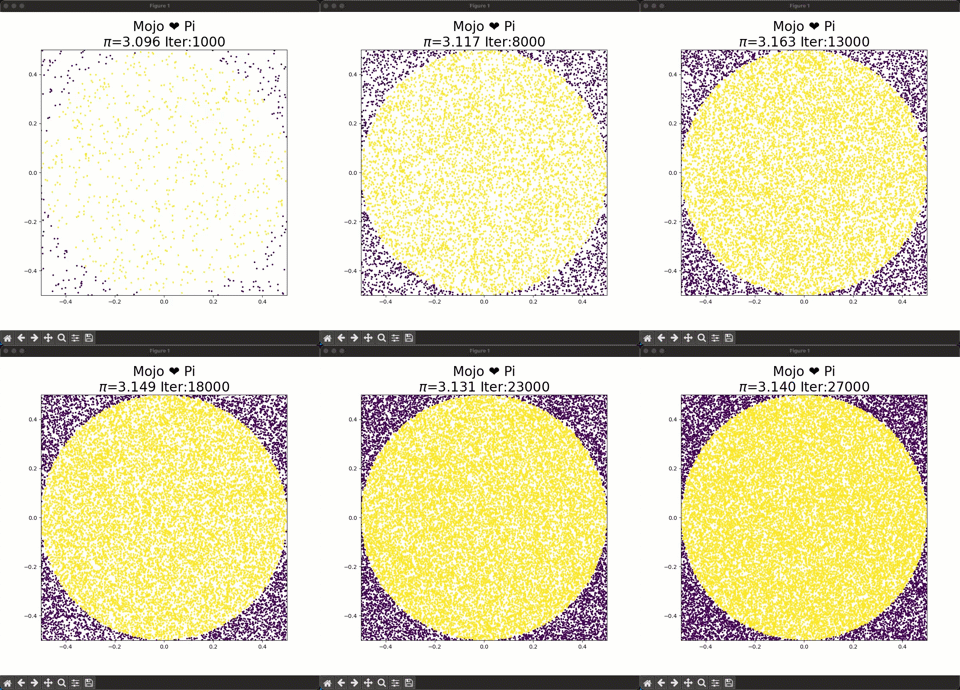
Mojo🔥 ❤️ Pi 🥧: Approximating Pi with Mojo🔥 using Monte Carlo methods
March 14th aka 3/14 or 3.14 is known as $\pi$ Day, and it honors the mathematical constant $\pi$ (pi), which represents the ratio of a circle's circumference to its diameter. On this special day, I wanted to dedicate a blog post to the beauty of mathematics, numerical methods, $\pi$, and Mojo. So join me on this journey as I implement a fast vectorized Monte Carlo approximation method of calculating $\pi$. Happy $\pi$ Day!

Evaluating MAX Engine inference accuracy on the ImageNet dataset
MAX Engine is a high-performance AI compiler and runtime designed to deliver low latency, and high-throughput inference for AI applications. We've shared how you can get started quickly with MAX in this getting started guide, and how you can deploy MAX Engine optimized models as a microservice using MAX Serving.

MAX is here! What does that mean for Mojo🔥?
When we started Modular, building a programming language wasn't our goal, it ended up being a solution to a set of problems. Specifically, as we were building our platform to unify the world’s ML/AI infrastructure, we realized that programming across the entire stack was too complicated.
Getting started with MAX Developer Edition
Today we’re thrilled to announce that MAX Developer Edition is now available in preview for developers worldwide! 🥳🎉. In this developer blog post, we'll take an in-depth look at MAX, its key features and capabilities, and how to use it to deploy your first MAX optimized model. Using code examples we’ll illustrate its benefits, cover key concepts, and share additional resources to continue your MAX journey.

Announcing MAX Developer Edition Preview
Modular was founded on the vision to enable AI to be used by anyone, anywhere. We have always believed that to achieve this vision, we must first fix the fragmented and disjoint infrastructure upon which AI is built today. As we said 2 years ago, we imagine a different future for AI software, one that rings truer now than ever before
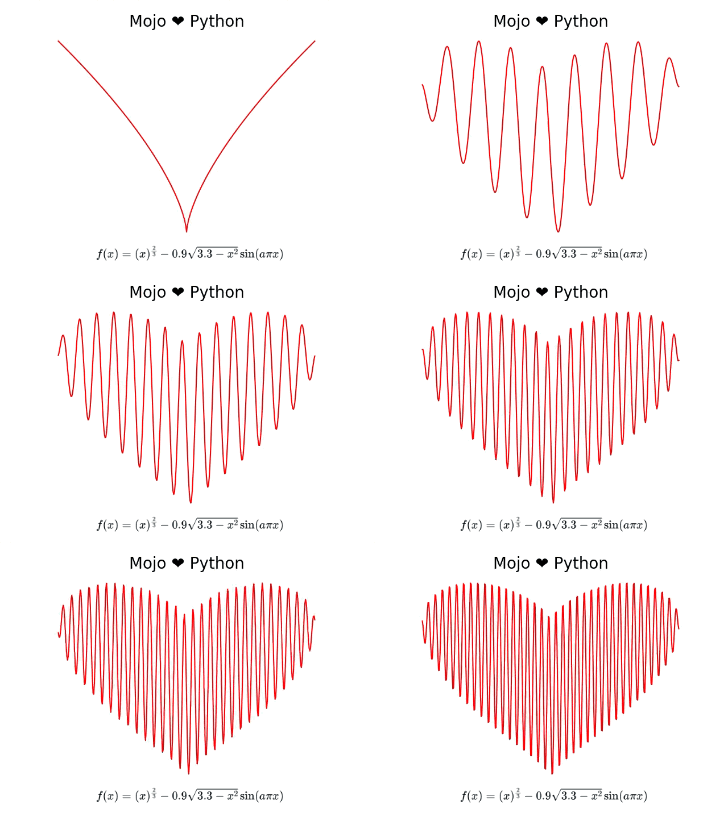
Mojo🔥 ♥️ Python: Calculating and plotting a Valentine’s day ♥️ using Mojo and Python
On Valentine’s Day yesterday, I wanted to create something special to celebrate my love for Mojo and Python. My search on the interwebs led me to a nifty little equation that plots a heart. The equation is quite simple and I’ll refer to this as the “heart equation” through the rest of this blog post

Mojo vs. Rust: what are the differences?
Mojo is built on the latest MLIR compiler technology, an evolution of LLVM which Rust lowers to. This enables programmers to write code optimized for different CPU architectures, and use the same ergonomic programming model to compile and run native GPU kernels
No items found within this category
We couldn’t find anything. Try changing or resetting your filters.

Get started guide
Install MAX with a few commands and deploy a GenAI model locally.
Read Guide
Browse open models
500+ models, many optimized for lightning-fast performance
Browse models