Blog

Democratizing AI Compute Series
Go behind the scenes of the AI industry with Chris Lattner

Modular 26.5: Mojo 1.0 is here!
Today, the Mojo language officially reaches 1.0: a milestone the language has been building toward since its first release in 2023. Mojo has grown into a general-purpose language with a vibrant developer community writing their own libraries, tools, and applications on top of it. With Mojo 1.0, developers can now build for the long-term on a stable, production-ready language foundation.


Translating to Mojo via AI Agents
At Modular, we’re always experimenting with the latest agentic programming tools, integrating the best ones into our workflows, and learning quite a few lessons along the way. One thing we realized is that the Mojo language is ideally suited to the needs of modern AI coding agents.

Inkwell: Why Your Inference Platform Matters As Much As Your Model
Inkwell is a web app that lets users create interactive storybooks with a custom character along infinite branching paths. When the user opens a story, the first page of text and image art streams in - text appears character-by-character via WebSocket within the first second, the illustration paints in as you read, and by the time you tap a choice, the next page is already written and illustrated. Creating a user experience around the seamless generation of new content requires an inference layer that can perform at scale.
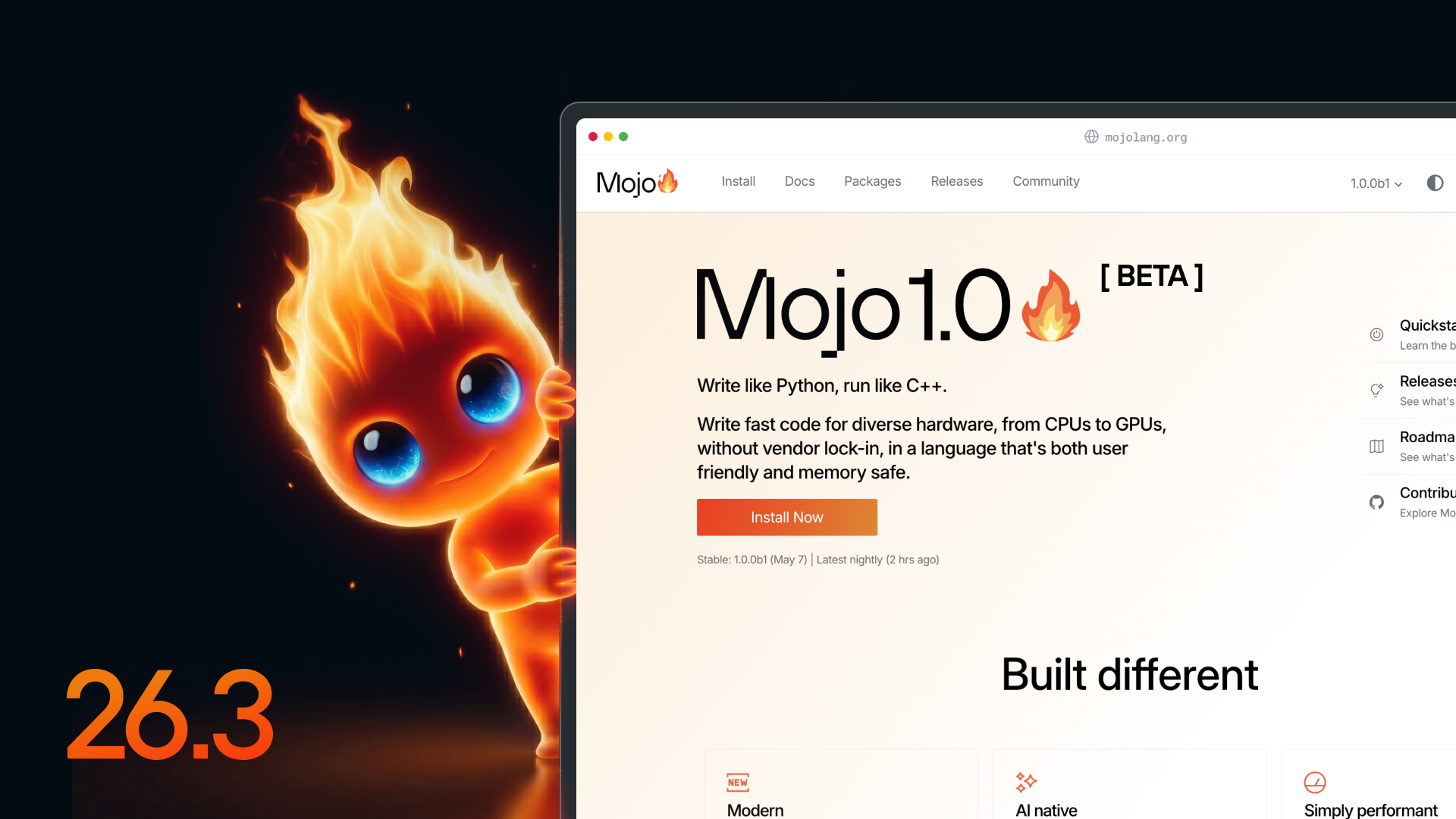
Modular 26.3: Mojo 1.0 Beta, MAX Video Gen, and more
Surprise: Mojo 1.0 is officially in beta! Modular’s 26.3 release includes new features and modalities, but the headline is that we’ve officially hit beta for Mojo 1.0, with a clear plan to finalize Mojo 1.0 in the coming months. We share details below, alongside other key announcements in our 26.3 release including video generation in MAX with Wan 2.2 and MAX framework updates.


Modular 26.2: State-of-the-Art Image Generation and Upgraded AI Coding with Mojo
Today’s 26.2 release expands the Modular Platform’s modality support to include image generation and image editing workflows. This extends our existing support for text and audio generation. In the 26.2 version Black Forest Labs' FLUX.2 model variants are supported with over a 4x speedup over state-of-the-art.

Modular 26.1: A Big Step Towards More Programmable and Portable AI Infrastructure
Today we’re releasing Modular 26.1, a major step toward making high-performance AI computing easier to build, debug, and deploy across heterogeneous hardware. This release is focused squarely on developer velocity and programmability—helping advanced AI teams reduce time to market for their most important innovations.

The path to Mojo 1.0
While we are excited about this milestone, this of course won’t be the end of Mojo development! Some commonly requested capabilities for more general systems programming won’t be completed for 1.0, such as a robust async programming model and support for private members. Read below for more information on that!

Modular 25.7: Faster Inference, Safer GPU Programming, and a More Unified Developer Experience
Today, we’re excited to release Modular Platform 25.7, an update that deepens our vision of a unified, high-performance compute layer for AI. With a fully open MAX Python API, an experimental next-generation modeling API, expanded hardware support for NVIDIA Grace superchips, and a safer, more capable Mojo GPU programming experience, this release moves us closer to an ecosystem where developers spend less time fighting infrastructure and more time advancing what AI can do.

Democratizing Compute
Go behind the scenes of the AI industry in this blog series by Chris Lattner. Trace the evolution of AI compute, dissect its current challenges, and discover how Modular is raising the bar with the world’s most open inference stack.

Matrix Multiplication on Blackwell
Learn how to write a high-performance GPU kernel on Blackwell that offers performance competitive to that of NVIDIA's cuBLAS implementation while leveraging Mojo's special features to make the kernel as simple as possible.

Structured Mojo Kernels
Learn how Mojo simplifies GPU programming with modular kernel architecture, compile-time abstractions, and zero-cost performance across modern GPU hardware.

Software Pipelining for GPU Kernels
Explore software pipelining for GPU kernels from first principles. We formalize dependencies as a graph, solve for the optimal schedule with a constraint solver, and show how it all integrates into MAX via pure Mojo.

Why LLM Inference Needs a New Kind of Router
This series walks through why traditional HTTP routing breaks down under LLM workloads and how Modular Cloud solves it with a three-layer architecture built for cache-aware routing.

TileTensor
This series walks through how Modular built TileTensor, a Mojo tensor type that lets kernel authors express complex memory layouts precisely, safely, and efficiently.
No items found within this category
We couldn’t find anything. Try changing or resetting your filters.

Sign up today
Signup to our Cloud Platform today to get started easily.
Sign Up
Browse open models
Browse our model catalog, or deploy your own custom model
Browse models