Blog




Democratizing AI Compute Series
Go behind the scenes of the AI industry with Chris Lattner
Latest
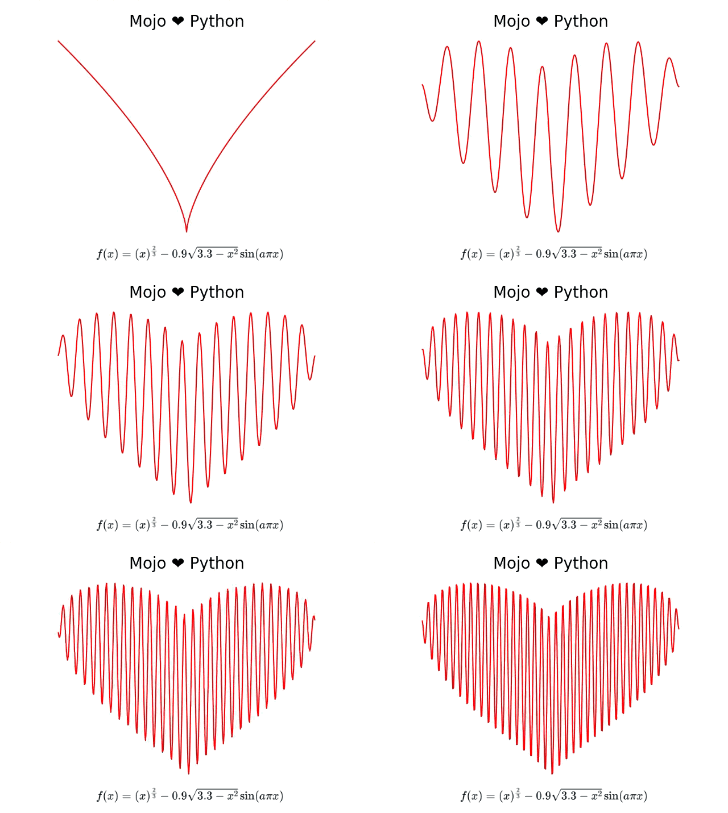
Mojo🔥 ♥️ Python: Calculating and plotting a Valentine’s day ♥️ using Mojo and Python
On Valentine’s Day yesterday, I wanted to create something special to celebrate my love for Mojo and Python. My search on the interwebs led me to a nifty little equation that plots a heart. The equation is quite simple and I’ll refer to this as the “heart equation” through the rest of this blog post

Mojo vs. Rust: what are the differences?
Mojo is built on the latest MLIR compiler technology, an evolution of LLVM which Rust lowers to. This enables programmers to write code optimized for different CPU architectures, and use the same ergonomic programming model to compile and run native GPU kernels

What is loop unrolling? How you can speed up Mojo🔥 code with @unroll
Open any introductory programming book and you’ll find several pages dedicated to structured programming concepts, i.e. making use of loops, conditions and functions extensively for better clarity and maintainability for your code. It helps you express your ideas and solutions neatly and elegantly in code. However, these benefits come at a cost: performance overhead.

Mojo🔥 SDK v0.7 now available for download!
Mojo SDK v0.7 is the first big release of Mojo🔥 in 2024, and it’s chock full of new language and standard library feature goodness. In this blog post, I’ll share some of the key highlights from this release with examples, and discuss what they are and when to use them. I’m only going to cover the new features, for a complete list of what’s new, what’s changed, what’s removed, and what’s fixed in this release, be sure to check out the changelog in the Mojo documentation.

Mojo 🔥 lightning talk ⚡️ one language for all AI programming!
Did you catch Fabian's presentation at SINTEF? If you missed out, he'll be doing it again in Oslo, Norway on the 15th of February!By popular request, we're publishing the slides here, and will soon have video to go with it. Make sure to subscribe to our YouTube channel to get the alert!

Modular partners with Amazon Web Services (AWS) to bring MAX to AWS services
Today, Modular is excited to announce a partnership with Amazon Web Services (AWS), the world’s leading and largest cloud server provider. Together, we are bringing the benefits of the MAX Platform to AWS production services everywhere, powering innovative AI features for billions of users around the world.
Modular to bring NVIDIA Accelerated Computing to the MAX Platform
The era of Generative AI is upon us. Companies around the world are exploring how it can transform their businesses, yet most are finding it challenging to economically and efficiently deploy these larger and more complex models into production.


Mojo 🔥 Advent of Code 2023
Advent of Code is an annual online coding event that takes place during the holiday season, starting on December 1st and continuing until December 25th. It consists of a series of small programming puzzles that are released daily, each becoming available at midnight EST (UTC-5). Participants from around the world compete for fun, honing their coding abilities and often learning new programming concepts in the process.
No items found within this category
We couldn’t find anything. Try changing or resetting your filters.

Sign up today
Signup to our Cloud Platform today to get started easily.
Sign Up
Browse open models
Browse our model catalog, or deploy your own custom model
Browse models