.png)

Just about three years ago, the Mojo language started its journey from little more than an idea. Mojo has sure grown up a lot since then, pushing the frontiers of today’s latest accelerators, powering MAX (which in turn drives world-leading AI models), and being adopted by countless developers for a wide range of applications spanning from audio processing to bioinformatics. Today, we’re excited to talk about the next big step in Mojo’s journey: Mojo 1.0!
Our vision for Mojo 1.0
We recently published our vision for Mojo as a language and why Modular built it in the first place. To quote from that document:
Our vision for Mojo is to be the one programming language developers need to target diverse hardware—CPUs, GPUs, and other accelerators—using Python's intuitive syntax combined with modern systems programming capabilities.
Alongside that, we provided our roadmap for Mojo’s development, broken into conceptual phases for the language. Phase 1 leans into Mojo’s initial killer application: writing high-performance kernels for GPUs and CPUs in a powerful, expressive language. The growing number of people learning GPU programming for the first time with our Mojo GPU puzzles is one testament to the value Mojo brings in this area. Mojo has allowed Modular to rapidly get the most out of the latest accelerators on the market and fuels all of Modular’s AI workloads.
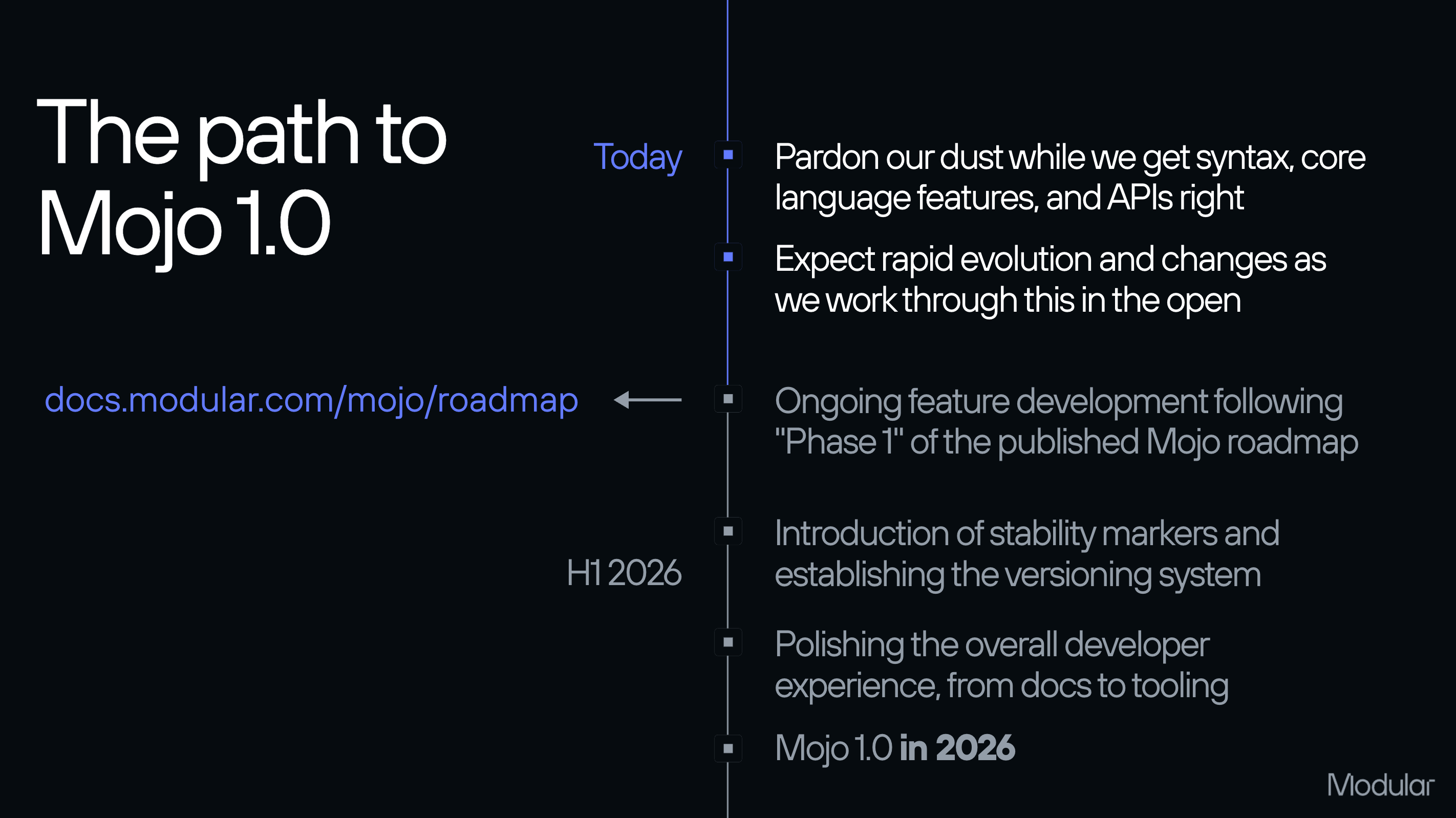
While we want Mojo to achieve its full roadmap potential over time, we also want to bring an epoch of stability to the Mojo development experience, and thus a 1.0 version. As such, Mojo will reach 1.0 once we complete the goals we’ve listed for Phase 1 in our roadmap, providing stability for developers seeking a high-performance CPU and GPU programming language.
Work is well underway for the remaining features and quality work we need to complete for this phase, and we feel confident that Mojo will get to 1.0 sometime in 2026. This will also allow us to open source the Mojo compiler as promised.
While we are excited about this milestone, this of course won’t be the end of Mojo development! Some commonly requested capabilities for more general systems programming won’t be completed for 1.0, such as a robust async programming model and support for private members. Read below for more information on that!
Why a 1.0 now?
A 1.0 version for Mojo makes sense now for several reasons: first, we’d like to establish an epoch of stability within the Mojo ecosystem. A vibrant and growing community has formed around Mojo, and more people are looking to build larger projects using it. To date, the rapid pace of change in Mojo and its libraries has been a challenge.
We want to make it much easier to maintain a Mojo project by giving developers the confidence that what they write today won’t break tomorrow. The introduction of semantic versioning, markers for stable and unstable interfaces, and an overall intentionality in language changes will provide an even more solid foundation for someone developing against Mojo 1.x.
Mojo packages that use stabilized APIs should keep building across the 1.x series, even as we continue to add in new features that don’t make 1.0 itself. This will let the growing number of community Mojo libraries interoperate, unlocking increasingly complex Mojo projects.
We’re excited to have more Mojicians come to the platform. Announcing a 1.0 for the language will be a sign to the rest of the world to come and try out Mojo, or to come back and see how it has grown since the last time they kicked the tires. That’s why it’s important to us to have an excellent documentation and tooling experience for new and returning developers.
Planning for Mojo 1.0 has also been hugely valuable to the Modular team, as it provides a forcing function for focus and prioritization. There’s so much that can be worked on when developing a language that it’s helpful to identify what we weren’t going to be able to do before 1.0. That lets us direct effort to making a more solid experience for what Mojo is great at today, and polish an initial set of features before adding more.
Regarding the Mojo standard library, we’ve planned to give sufficient time to run each new language feature through it. This lets us identify bugs or areas of improvement before we call a feature “done”. We also expect 1.0 to have relatively few library features “stabilized” and expand that scope over time incrementally.
What’s next after 1.0?
Mojo 1.0 will be a milestone to celebrate, but it is only a step in a much longer journey. There are many features that won’t quite make the 1.0 launch, some of which we plan to roll out incrementally in 1.x releases. Many of these features (e.g. a “match” statement and enums) will be backward compatible and won’t break existing code, so we can add them into 1.x releases.
That said, we know that Mojo 1.0 won’t be perfect! There are some important language features in Phase 2 of the Mojo language roadmap that will introduce breaking changes to the language and standard library. For example, the ability to mark fields “private” is essential to providing memory safety.
During the development of Mojo 1.x, we will announce plans for a source breaking Mojo 2.0, and will build support for it under an “experimental” flag to allow opt-in support to this language mode. This means the Mojo compiler will support both 1.x and 2.0 packages, and we aim to make them link compatible - just like C++’20 is source incompatible with C++’98, but developers can build hybrid ecosystems. We will then enable package-by-package migration from 1.x to 2.x over time when 2.0 converges and ships.
Right now we are laser-focused on getting 1.0 out the door, but we have great confidence we’ll be able to navigate this future transition smoothly. Mojo learns a lot great things from Python, as well as from things that didn’t go as well: we’ll do what we can to avoid a transition like Python 2 to 3!
Join the community and follow along!
Our work towards Mojo 1.0 will be done in the open, and we welcome feedback and pull requests that help make the language even better. There are some great ways to participate:
- Check out the new language and library additions as they roll out on a nightly basis in our open-source
modularrepository. - Have detailed discussions about language and interface design in the Modular forum.
- Visit our new community page for even more resources.
Mojo 1.0 will be a big step for the language in the year to come!
Discover what Modular can do for you